How dark is the sky in Espoo?
Brighter with snow. This reading is for snow-free ground. Fresh snow reflects most of the streetlight that falls on it back up into the sky, so on a snowy winter night the sky over Espoo is brighter than shown, more so under cloud. How it works
Where is the nearest dark sky to Espoo?
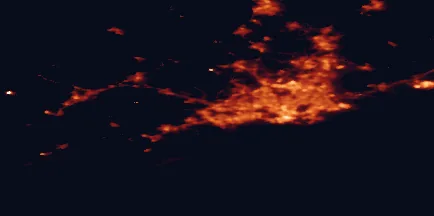
Lights around Espoo seen from orbit
NASA satellite image of light at night, 2025. The rings mark distances from Espoo.
Where are the darkest skies near Espoo?
The darkest places you can drive to, up to 50, 100 and 150 km from Espoo. Roadless country nearby can be darker still.
None of these spots can be reached by car: there are no roads to them, or only by ferry or a long hike. Use them to see where the darkest land is.
A spot closed at night, or a number that looks wrong? Let us know.
Where are the observatories near Espoo?
Observatories within 150 km, with the modeled sky at each. Older ones often sit inside towns, newer ones were built where it is dark. Many are research or club sites, so check opening times before you go.
Almost black on purpose: there's next to no artificial light within this circle. This is what a dark sky looks like from orbit.
Which towns light up the Espoo horizon?
The compass shows where the glow on the horizon comes from, counting all light more than 5 km away. The table names the towns behind it, including Espoo's own outskirts.
| Source | Distance | Share |
|---|
Has the sky over Espoo gotten brighter?
Each point is how much artificial light added to the natural brightness of the sky overhead that year: 0% is a natural sky, 100% means twice as bright. Same satellite every year; it barely sees the blue part of white LED light, so recent years probably read too dark.
Clear nights in Espoo by month
The average number of nights each month with less than 30% cloud, from NASA POWER satellite records.
When is Milky Way season near Espoo in 2027?
Nights in each month when the Milky Way core stands more than 10° above the horizon for at least an hour of moonless astronomical darkness. At 60.2° north the core peaks at about 1° high, so a clear southern horizon matters. These are calculated positions of the sun, moon and Milky Way; whether a night is clear is only known closer to the date.