When is Milky Way season in Canada?
On moonless nights the bright core of the Milky Way stands clear of the horizon in Canada from April to July. It climbs highest in the south: about 19° above the horizon at Point Pelee National Park, Ontario, and only about 12° at Waterton Lakes National Park, Alberta. Further north it never clears 10° while the sky is fully dark: 104 of the 235 places on Yozora Atlas in Canada have no Milky Way core nights at all.
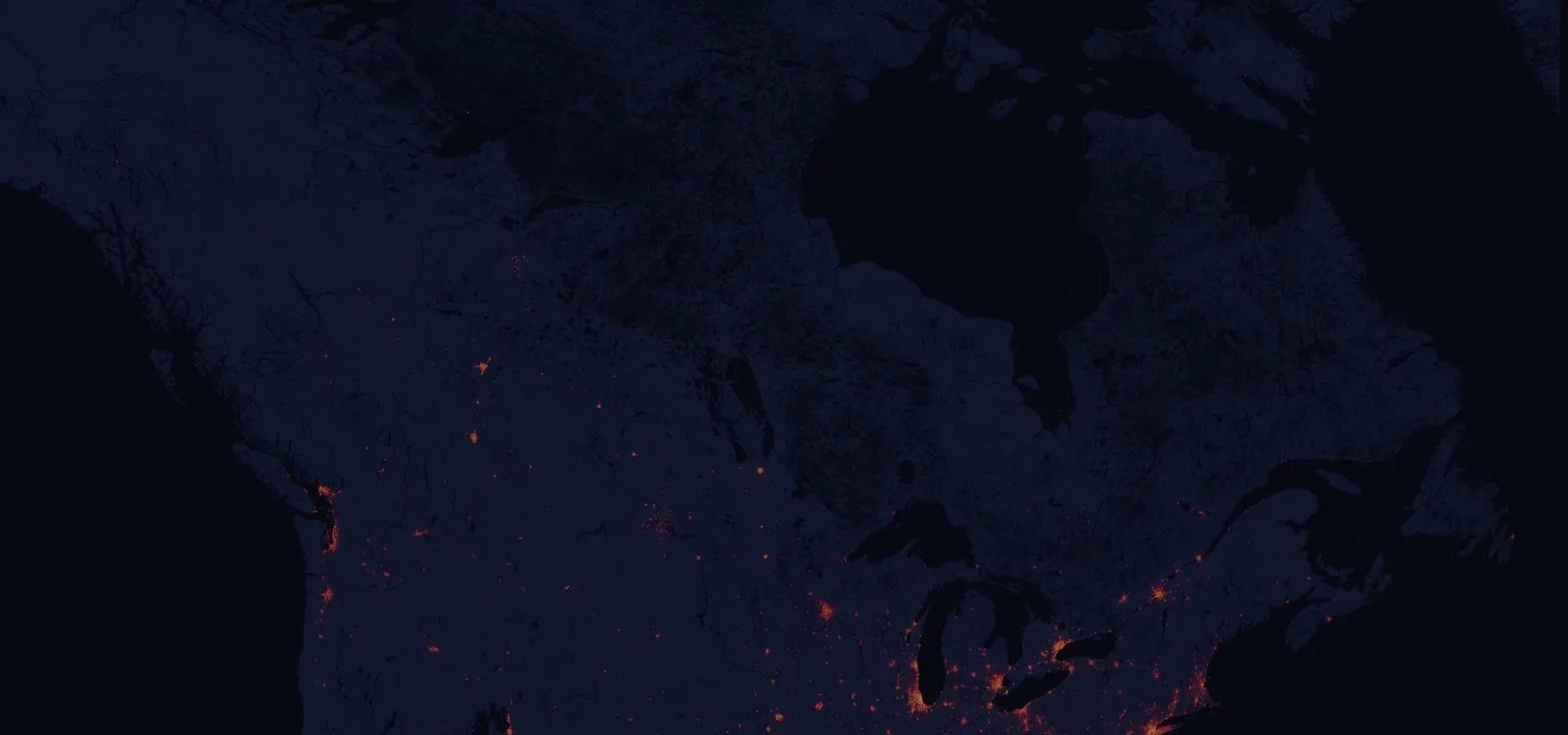
When is Milky Way season in each part of Canada?
The months when most of a region’s places have the core up, how high it climbs at the region’s southern edge, the median core nights in 2027, and the darkest place to see it from.
| State or region | Season | Core height | Nights in 2027 | Darkest place to see it |
|---|---|---|---|---|
| Ontario | April to August | up to 19° | 88 | Lake Superior Provincial ParkBortle 2, 44 nights |
| Nova Scotia | April to August | up to 17° | 80 | Sable Island National Park ReserveBortle 2, 88 nights |
| New Brunswick | April to July | up to 16° | 69 | Mount Carleton Provincial ParkBortle 3, 47 nights |
| Prince Edward Island | May to July | up to 15° | 61 | Pituamkek National Park ReserveBortle 4, 59 nights |
| Quebec | April to July | up to 16° | 60 | Gaspésie National ParkBortle 3, 10 nights |
| Newfoundland and Labrador | May to July | up to 14° | 12 | Terra Nova National ParkBortle 3, 27 nights |
| Alberta | May to June | up to 12° | 0 | Writing-on-Stone Provincial ParkBortle 3, 6 nights |
| British Columbia | May to June | up to 13° | 0 | Akamina-Kishinena Provincial ParkBortle 3, 9 nights |
| Manitoba | no core nights | under 10° | 0 | none |
| Northwest Territories | no core nights | under 10° | 0 | none |
| Saskatchewan | May to June | up to 12° | 0 | Grasslands National ParkBortle 2, 4 nights |
| Yukon | no core nights | under 10° | 0 | none |
The darkest places in Canada with the most Milky Way nights
Bortle 1 to 3 places, by nights in 2027 with the core more than 10° up for an hour of moonless darkness.
- Kejimkujik National Park Nova Scotia · Bortle 3 · core up to 17°88 nights
- Sable Island National Park Reserve Nova Scotia · Bortle 2 · core up to 17°88 nights
- Bruce Peninsula National Park Ontario · Bortle 3 · core up to 16°77 nights
- Algonquin Provincial Park Ontario · Bortle 3 · core up to 15°71 nights
- Killarney Provincial Park Ontario · Bortle 3 · core up to 15°68 nights
- Marten River Provincial Park Ontario · Bortle 3 · core up to 14°60 nights
- Cape Breton Highlands National Park Nova Scotia · Bortle 3 · core up to 14°59 nights
- Mount Carleton Provincial Park New Brunswick · Bortle 3 · core up to 14°47 nights
- Lake Superior Provincial Park Ontario · Bortle 2 · core up to 13°44 nights
- Hautes-Gorges-de-la-Rivière-Malbaie National Park Quebec · Bortle 3 · core up to 13°37 nights
Which months have the most Milky Way nights in Canada?
The median place has the core up on the most moonless nights in June. The core rises before dawn in spring, is up most of the night in early summer and sets in the evening by autumn; each place page lists its own nights and the 2027 new moons.
How the Milky Way dates for Canada are calculated
The positions of the sun, the moon and the center of the Milky Way are calculated for every night of 2027 at each place. A night counts when the core stands more than 10° above the horizon for at least an hour while the sun is more than 18° below the horizon and the moon has set. These are calculated positions; whether a night is clear is only known closer to the date. How it works