Where can you see the northern lights in Denmark?
All 41 places on Yozora Atlas in Denmark see the northern lights on their northern horizon in a storm of Kp 7 or less. Bulbjerg, North Denmark, needs only Kp 5, a minor storm, which has happened on about 39 nights a year since 1932. At the southern edge, in Copenhagen, it takes a moderate storm (Kp 6), about 14 nights a year. Those are nights with enough activity, not sightings: clouds and the moon hide many of them.
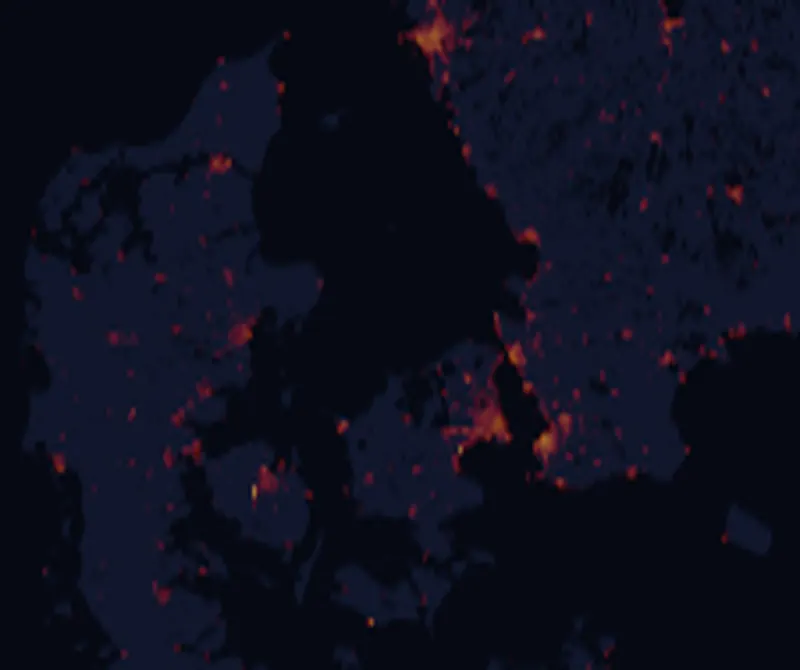
Which parts of Denmark see the northern lights most often?
Each region with the Kp range of its places, the nights a year its best place reaches that level, and the darkest place to watch from.
| State or region | Places | Kp needed | Nights a year | Darkest place to watch from |
|---|---|---|---|---|
| Central Jutland | 12 | Kp 5 to 6 | 39 nights | AnholtBortle 3, Kp 5 |
| North Denmark | 6 | Kp 5 | 39 nights | BulbjergBortle 3, Kp 5 |
| Capital Region | 5 | Kp 6 | 14 nights | Kongernes Nordsjælland National ParkBortle 4, Kp 6 |
| South Denmark | 9 | Kp 6 | 14 nights | MandøBortle 4, Kp 6 |
| Zealand | 9 | Kp 6 | 14 nights | NyordBortle 4, Kp 6 |
The darkest places in Denmark to watch the northern lights
The towns in Denmark where the northern lights show most often
- Bulbjerg North Denmark · Bortle 3 · Kp 539 nights
- Thy National Park North Denmark · Bortle 3 · Kp 539 nights
- Anholt Central Jutland · Bortle 3 · Kp 539 nights
- Fussingø National Nature Park Central Jutland · Bortle 4 · Kp 539 nights
- Rebild Bakker North Denmark · Bortle 4 · Kp 539 nights
- Mandø South Denmark · Bortle 4 · Kp 614 nights
- Nyord Zealand · Bortle 4 · Kp 614 nights
- Møn Zealand · Bortle 4 · Kp 614 nights
- Mols Bjerge National Park Central Jutland · Bortle 4 · Kp 614 nights
- Kongernes Nordsjælland National Park Capital Region · Bortle 4 · Kp 614 nights
- Skive Central Jutland · Kp 539 nights
- Silkeborg Central Jutland · Kp 539 nights
- Holstebro Central Jutland · Kp 539 nights
- Hjørring North Denmark · Kp 539 nights
- Viborg Central Jutland · Kp 539 nights
- Herning Central Jutland · Kp 539 nights
- Randers Central Jutland · Kp 539 nights
- Frederikshavn North Denmark · Kp 539 nights
- Aalborg North Denmark · Kp 539 nights
- Holbæk Zealand · Kp 614 nights
Nights a year since 1932 with the Kp level the place needs, between 9 pm and 3 am. These are nights with enough activity, not sightings: clouds and the moon hide many of them, and away from the far north a display is often a faint glow low in the north that a phone camera shows better than the eye. From inside a town only bright displays show through the glow: each town page names the closest dark spot without the town in its northern sky.
When are the northern lights most likely in Denmark?
Averaged over the 41 places, the most nights with a strong enough storm during darkness come in March and September: geomagnetic storms are more frequent around the equinoxes, and the nights are long enough to see them. In June 20 of the 41 places have no night dark enough, the sun staying less than 12° below the horizon. Clouds are not counted here; each place page has its clear nights by month.
How the Kp levels and night counts for Denmark are worked out
The aurora forms in a ring around the magnetic north pole, and the stronger a geomagnetic storm, the further south it reaches. Storm strength is measured by the Kp index, from 0 (quiet) to 9 (extreme). For each place the Kp level comes from its magnetic latitude, using the rule NOAA uses: the edge of the aurora sits at 66.5° magnetic latitude at Kp 0 and about 2° further south per step. It can be off by one level, and a phone camera often shows a display the eye barely sees. How often that level was reached comes from the Kp record of GFZ Potsdam, 1932 to 2025. None of this is a forecast: for tonight, see NOAA’s 30-minute aurora forecast. How it works